The Insidious Business Model
FOLLOW THE MONEY
Why they want your home, not your cash

They'll tell you Funding Circle is different. A partner to small business. Fast, friendly, modern. Here's how the business actually works.
This is not an allegation of illegality. It is an examination of a business model, one that explains why a cash settlement offer might be rejected in favour of a charge over your home. The model is patient. The model is profitable. The model is working exactly as designed.
Stage 1: The upfront take
Before you make a single payment, Funding Circle has already made their money. The economics are front-loaded:
- Transaction fees are earned when loans are originated
- Completion fees are taken from your advance before you see the money
- Servicing fees are earned while loans perform
In our case, a 10% completion fee meant we received less than the headline amount. The fee was deducted before the money reached us. By the time you sign, the platform has already won. Everything after this is upside.
Stage 2: The loan
The interest rate on our loan was 16.9%. At the time, base rate was around 1.25%. That's more than thirteen times the base rate. Interest is front-loaded in early payments. You pay for years. The principal barely moves.
We made 27 consecutive monthly payments. We never missed one. We paid back over two-thirds of what we borrowed. Nearly half of that went to interest. And then our business failed.
Stage 3: When things go wrong
This is where the model gets interesting. We had repaid over two-thirds of the loan. We expected to owe less than a third. Instead, Funding Circle claimed we owed more than the original loan amount. How is that possible?
The trick: "contractual interest." When you default, Funding Circle doesn't just claim the outstanding principal. They claim interest for the remaining term of the loan, months that will never happen.
What does that mean? Interest is supposed to compensate a lender for the time you have their money. If you borrow for 27 months, you pay interest for 27 months. That's fair. But Funding Circle's contract says that if you default, they can charge interest as if you still had the loan for the full term, even though you don't and won't.
Think of it like a gym membership. You sign up for six years. After 27 months, the gym closes down. You'd expect to stop paying. But imagine the gym demanded you pay the remaining 45 months of membership fees, for a gym you can no longer use. That's contractual interest.
In our case, we had the loan for 27 months out of a 72-month term. They claimed interest as if we would have it for all 72 months. That's 45 months of interest for lending that will never occur. On top of that: a 10% "collections charge" added to the balance.
The result: you can pay back over two-thirds of what you borrowed and still owe more than you started with.
Stage 4: The recovery play
When we made a settlement offer, we expected negotiation. A counter-offer. A discussion about what was realistic. Instead, we got rejection, not because the amount was too low, but because they wanted something else entirely. They wanted a charge on our home.
Their position, made explicit in correspondence: we could pay almost nothing each month, a token amount, but only if we secured the debt against our property. Think about what that means:
- Cash settlement closes the file
- A charge on the property keeps the debt alive
- They'd rather have security that waits than cash that ends
This is not about recovering money. It's about securing assets.
Stage 5: The patient predator
Once a charge is on your home, Funding Circle doesn't need to chase you. They don't need to take you to court. They don't need to evict you. They just wait. Their own words, from correspondence about settlement:
"Should you elect to sell the property... we would expect to be paid in full from the sale proceeds."

Sale or death. Either way, they get paid. The charge is patient.
This is the genius of the model:
- "We never evict families"
- "We work with borrowers in hardship"
- "We offer affordable payment plans"
All true. All misleading. They don't need to evict anyone. The charge does the work. Time does the work. They can afford to look reasonable because they've already secured the outcome.
The numbers that prove it
In January 2026, Funding Circle announced their annual results:
| Metric | 2024 | 2025 | Change |
|---|---|---|---|
| Profit before tax | £3m | £20m | +567% |
| Revenue | £159m | £204m | +28% |
Profits increased 567% in one year. They hit their 2026 revenue target a year early. Shares jumped 16% on the announcement. They announced £25 million in share buybacks.
Meanwhile, families like ours are pressured to put charges on their homes while dealing with business failure, illness, and financial ruin. The model is working, for them.
What their own accounts reveal
From Funding Circle's published financial statements:
- Loss Given Default (LGD): 84.4% - on average, they expect to recover only 15.6% of defaulted loans
- Collection charges are revenue - not cost recovery, but a profit centre
- Debt sales confirmed - non-performing loans sold to third parties at discount
But here's the key: 84.4% loss is the average. That includes cases where there's nothing to recover. If they can get a charge on your home? They recover everything. You're not a write-off. You're an asset.
That's why they reject cash settlements. That's why they want security. A charge on a property with equity is worth far more than the average recovery.
The structural tension
Funding Circle's marketing engine is designed to:
- reduce friction
- accelerate decision-making
- bring large volumes of small businesses "in the door"
Their recoveries ecosystem is designed to:
- maximise enforcement outcomes
- monetise defaulted assets
- pursue personal guarantees where available
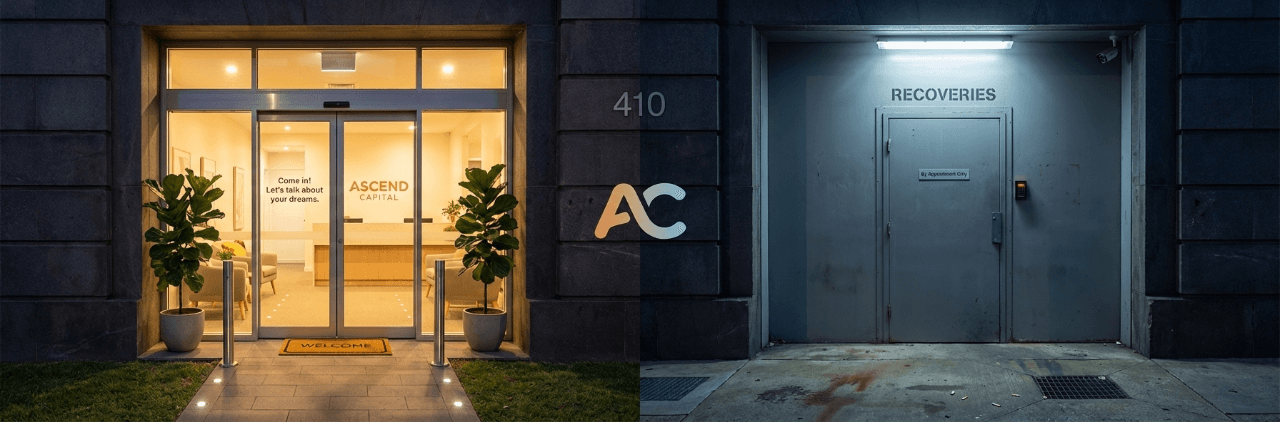
Those two worlds coexist within the same system. The friction arises when borrowers discover, often in crisis, that the second world bears little resemblance to the first.
Why business owners should know this
Before you sign:
- Understand the Personal Guarantee - it targets your home, not just the business
- Understand the contractual interest clause - you could owe for years you never use
- Understand what "working with you" might mean - securing your home, not settling your debt
The loan isn't the product. You are. They make money when you sign. They make money while you pay. And if things go wrong, they make money by waiting, with a charge on your home that outlasts you.
What we learned
We thought we were dealing with a lender. We were dealing with a business model. The friendliness at the start, the pressure at the end, the "reasonable" offer of a charge instead of eviction: it's all part of the same machine.
The machine is patient. The machine is profitable. The machine is working exactly as designed. That's not a partnership. That's a trap with a longer fuse.